At LEO, we believe those closest to the problem are closest to the solution. That's why in this series, you'll be hearing directly from Those Closest—the LEO partners and changemakers whose daily work makes building evidence possible. These are poverty's fiercest adversaries, showing us not just what works, but why it matters.
Stepping Up and Not Going Back
By: Kristina Luera, MA, LPC-S, LSOTP-S
Rehabilitation Coordinator
Lubbock County Detention Center
It surprises people when I tell them about some of the men in our program. People expect chaos, anger, and violence. They assume a certain outcome of hopelessness—that if someone in jail ever gets the opportunity to get out and make better choices, they won’t. And while jail is an entirely different environment than the world you and I live in—that’s not the experience for those I oversee.
I have the privilege of running a voluntary therapeutic program in the Lubbock County Detention Center called Step Up. An intense but short 14-to-21-week waitlisted program, we focus on therapy, structure, community, and accountability. It’s not a checklist, and certainly not a get-out-of-jail-free card. Some of the men in our program aren’t getting out anytime soon. Some are headed straight to prison. But even then, the work we do matters. It changes everything about the incarceration process—from individuals to staffers to recidivism rates.
Every morning at 8am, our guys come out to a community room to prepare for class, work on their therapy homework or projects, and socialize with one another through games, art, and conversation. I remember one man who was so anxious when he arrived, he could barely speak. His hands shook constantly. Yet week after week, he kept showing up. By the end of the program, he was standing up in front of everyone singing in the talent show.
Another young man spent two years in solitary confinement. He was disruptive, angry, and always causing trouble. We gave him a choice: join our program using a Behavioral Management Contract or go back to solitary. He joined us. When he graduated from our program and later left for prison, he had become one of the most respectful people to live inside of these walls. The officers noticed it. Other inmates noticed it. Later, we heard from people in prison that he’s still practicing what he learned.
When inmates learn to manage their emotions, build social skills, and take responsibility, the jail becomes safer, and the outcomes are better.
Someone I think about regularly is a man in his forties who didn’t say much when he came to us. He had been through other mandatory “checklist programs,” as he called them. When he started Step Up voluntarily, something shifted.

He had been in a toxic relationship with someone who used drugs, and this ultimately was what landed him in jail. He told me later that part of him stayed with her because he was desperate to feel loved. But through the program, he started learning how to set boundaries. When he got out of jail, he broke up with this person. He had learned to love himself.
He found work landscaping in Texas. He reconnected with his kids, who he was finally allowed to see via an open adoption. Recently, he invited me to attend his two-year sobriety check-in as his support as no one else he invited was able to attend. He trusted I would be there for him. Most importantly, he hasn’t come back to jail.
One graduate told me recently, “You helped save my life. I didn’t stop working on myself after Step Up. I got myself into classes and programs in prison that elevated my mindset and spirit. I wish I could show you how much more I applied myself in prison. It started with you and the Step Up program.”
The stigma ‘once a criminal, always a criminal’ simply isn’t true. Some of the men we work with are facing charges of 3-4 years, some 40-50. Some are young, 17-year-old kids charged as adults. Many come from poverty, or they were abandoned by their families, or they were stuck raising their siblings, or they fell into the wrong crowd at an early age. In so many other contexts, we would treat them for trauma. Punishment alone is not effective. Healing is harder, but with Step Up, it works for anyone willing to put in the work.
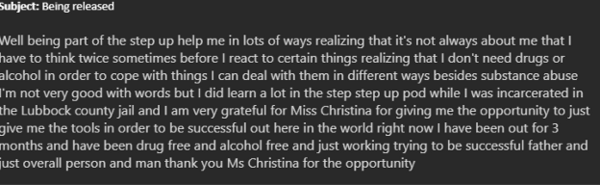
Occasionally we get letters from inmates. One came from a young man in his early twenties. He had lost custody of his children through CPS. During his time with us, he started the long process of repairing those relationships. While in jail, he took the program seriously as he fought for custody of his kids and won before he was released. In his letter, he thanked us for helping him believe he could be a good father again. He told us about the life he’s planning to build for his kids. One that maybe wouldn’t have been possible before.
This program keeps going with the help of many volunteers and a handful of mentors, six men who graduated from the program and now help run it. They organize supplies, clean, distribute materials, and help keep order. We have created hope, purpose, a toolbox, and a chance for so many. But there are still so many more people who deserve another chance.
This handwritten letter by one of our graduates, from the prison he is now in, may sum it up best:
“I learned to understand why I acted out when I was young, and how learning how to forgive myself and others was just the beginning. Changing my way of thinking was challenging, but you never gave up on me. I try to teach others what I have learned, and many are interested. People want help but have nowhere to turn. Is there any way I could get an outline of your curriculum to help me teach others? Please, I know that if I can change, others can too. Your program was a blessing to me. Even my victim forgave me.”


Still, many of our graduates are going back into the community, and as those of us living in it know, it can be even tougher with a stigma on your back. Step Up is our best shot at giving these men the tools to succeed so we are not recycling individuals with potential back into a system that will further break them. We are helping our inmates transform themselves so that they have an exit strategy that works and a support system to hold them accountable. We are walking them to the door with skills, techniques, and the power of choice to live a different way so that they don’t ever have to come back.