Our Evidence Matters Webinars
Our Upcoming Webinar
Cross Departmental Collaboration: The Impact of Eviction on Children
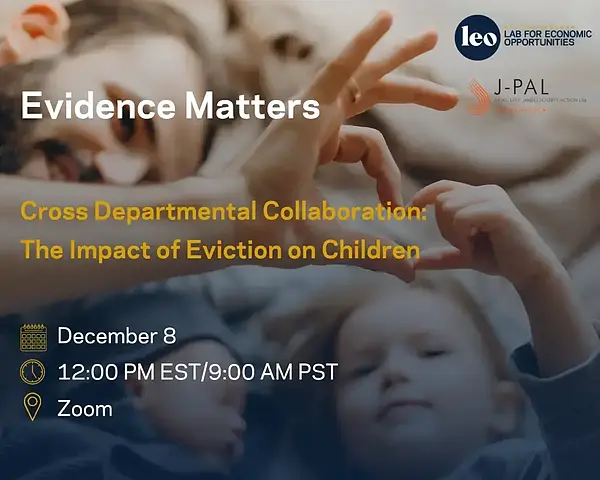
New research from Connecticut by economists at the University of Notre Dame, the University of Chicago, Yale University, and the University of Nebraska highlights that for children, the impacts of eviction go beyond housing. The study is the first to present rigorous, causal evidence that eviction is a hardship that tips the scale for children already experiencing poverty, having profound and persistent effects on children’s lives. This new evidence compares children who experience eviction to other children living in poverty and finds that eviction leads to a three-fold increase in a child’s likelihood to become homeless, has about the same impact on high school graduation as juvenile incarceration, and leads to other severe disruptions to their education, among other stressors.
Join us for our final Evidence Matters webinar of 2026 to learn about the impacts of eviction on children and how policymakers and others can respond. You’ll hear from the researchers and a public sector leader involved in the study on how they facilitated collaboration across state governments to measure outcomes beyond housing.
We’ll discuss:
- Impact of eviction on children: how housing loss affects families long-term
- How the study came about: what motivated the collaboration among researchers and government staff
- Collaboration: how bringing together data across departments can unlock learning
- Policy implications: practical steps State and local jurisdictions can take
Featured Perspectives:
- Rob Collinson, Wilson Family LEO Assistant Professor of Economics, University of Notre Dame
- Winnie van Dijk, Assistant Professor of Economics, Yale University
- Steve DiLella, Director of Individual and Family Support Program Unit, Connecticut Department of Housing
Event Details:
- Date: December 8th, 2026
- Time: 12:00pm-1:00pm EST / 9:00am-10:00am PST
What is Evidence Matters?
Evidence Matters is a collaborative learning series hosted by the Wilson Sheehan Lab for Economic Opportunities (LEO) at the University of Notre Dame and J-PAL North America at MIT, with expert guidance from public sector evidence leader Carrie S. Cihak. Originating in 2021 as a partnership between LEO and King County, Washington, the series brings together government, researcher, and community perspectives to showcase successful partnerships that promote rigorous learning to advance equitable evidence-based economic mobility outcomes.
Mission, Vision, and Values
Mission: Supporting local governments, researchers, and social service providers as they embed evidence into every stage of decision-making, from policy development, to program design, to implementation.
Vision: Equitable community outcomes are advanced through increased collaboration among local government, practitioners, researchers, and policy organizations.
Values:
- We focus on research that is in the service of improving outcomes.
- We hold the expertise of practitioners, communities, and researchers in equal regard.
- We share and learn from practical, real-world examples of what works to increase economic mobility.
- We emphasize continuous learning over singular quantitative results.
- We believe research methods must be matched to the learning questions and context. While Evidence Matters focuses on methods using Randomized Controlled Trials (RCTs), we hold space to discuss the necessary ‘building blocks’ of evidence creation and learning that occur before an RCT is feasible, during a study, or after quantitative analysis is complete.
Past Evidence Matters Events
- September 2026, The Path to Greater Impact: Evidence Partnerships for Replication and Scale
- June 2026, From Line Items to Impact: Incorporating Evidence into Local Budgeting
- March 2026, 10 Lessons for Building Government and Research Partnerships That Matter
- November, 2025, Evidence Matters Convening
- August, 2025, From Evidence to Action: Replicating Effective Homelessness Prevention Across Communities
- May, 2025, Co-Designing for Equity: Antiracist Practice in Research and Evaluation for Greater Public Impact